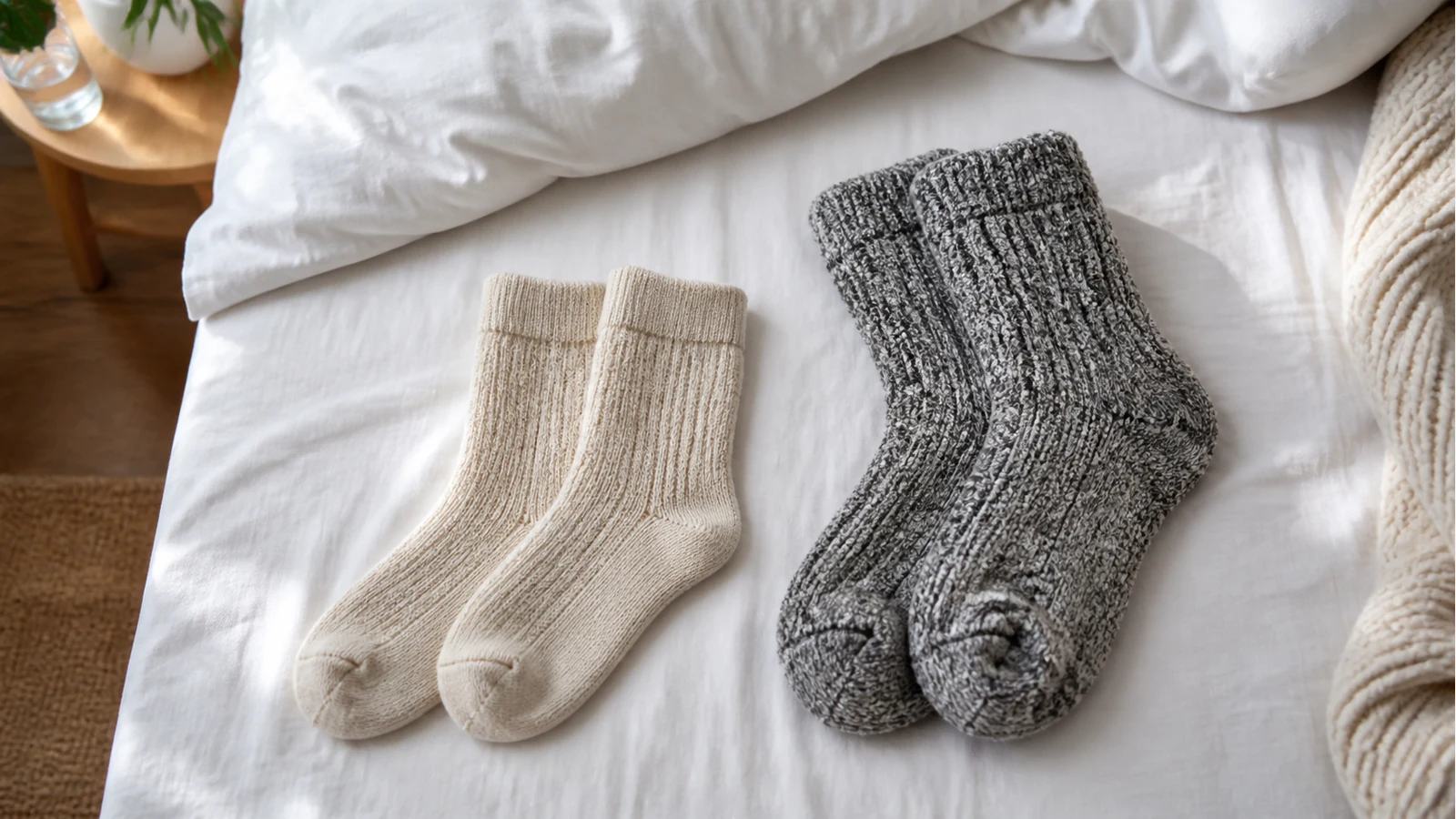
Bed Socks That Do Not Make Feet Sweat: How to Choose Breathable Warmth
Direct answer: bed socks that do not make feet sweat are usually not the heaviest pair on the shelf. They are the pair that balances warmth, breathability, cuff comfort and your bedroom temperature. If your feet sweat because the room is too warm, the duvet is too heavy, or you are wearing outdoor thermal socks to bed, changing socks alone will only partly help.
The The Sleep Charity bedroom-temperature advice gives a useful UK sleep-environment cue: many adults sleep best around 16-18C, with colder rooms making it harder to drop off and hotter rooms causing restlessness. The The Sleep Charity keeping-warm-in-bed tips also points to natural fibres such as cotton, wool or silk for warmth and mentions soft bed socks as an extra layer. That does not mean every cotton sock is warm enough or every wool sock is breathable enough for you. It means the decision should begin with the whole sleep setup.
Decision Table
| Reader problem | Likely better choice | Trade-off |
|---|---|---|
| Feet are cold at lights-out but clammy by 3am | Breathable mid-weight bed socks | Less extreme heat, more stable comfort. |
| Bedroom is very cold and feet never warm up | Warmer wool or layered bedding plus socks | May feel too warm if the room later heats up. |
| Fleece thermal socks feel sweaty | Natural-feel cotton-rich or wool-rich knit | May need careful washing and slower drying. |
| Skin is sensitive to coarse fibres | Softer cotton-rich knit or smooth wool alternative | Check seams, cuff and return policy carefully. |
| Sweating is new, heavy or unexplained | Stop and investigate symptoms | This is not a sock-selection problem first. |
Why Warm Socks Become Clammy
Clamminess is usually a system problem. A thick sock traps warm air, which is useful at first. If the fibre, room and bedding trap too much heat and moisture, your skin feels damp. Once damp, the same sock can feel colder because moisture changes the sensation against your skin. This is why a breathable sock can feel better than a maximum-thermal sock for bedtime even if it feels less dramatic when first pulled on.
Fit matters too. A tight cuff can feel secure but uncomfortable during sleep. A very loose cuff can twist, bunch or slide. Look for enough stretch to hold the sock without a hard ring around the leg. If you are considering a mid-calf slouch style, the relevant question is not whether it is the warmest possible sock; it is whether relaxed indoor warmth, breathable feel and loose-cuff comfort are your actual priorities.
What Certification Can and Cannot Tell You
Certification language is useful, but it should be read precisely. The GOTS version 8.0 update says GOTS version 8.0 was released in March 2026, and the OEKO-TEX STANDARD 100 explanation explains STANDARD 100 as harmful-substance testing for textile-related goods. Those sources help you understand what certification terms are intended to mean. They do not prove a specific product claim unless the product has verifiable certificate details. Treat named standards as confidence signals to check, not as a substitute for fit, warmth and care decisions.
Buying Checklist
- Choose a breathable warmth level before choosing maximum thickness.
- Check whether the cuff is relaxed enough for sleep but not so loose that it twists.
- Check the care routine; natural-feel soft socks may need gentle washing and air drying.
- Do not wear thick bed socks inside tight shoes the next morning.
- Use separate grip footwear if you get out of bed onto smooth floors.
Who Should Not Buy Breathable Bed Socks as the Main Fix
Do not make this your main fix if you are trying to solve heavy night sweats, sudden sweating changes, numbness, toe colour change or persistent pain. Also skip this route if what you truly need is outdoor cold-weather insulation. A breathable bed sock is for indoor comfort under bedding, not for extreme cold, wet outdoor use or medical circulation support.
Stop Conditions
Stop treating the issue as a material comparison if your toes become painful, numb, pale or blue when cold, or if symptoms are very bad or getting worse; the NHS Raynaud’s guidance gives those as relevant Raynaud's warning patterns. If dampness is paired with skin breakdown, recurring sores or unexplained health changes, choose medical advice before another sock purchase.
Conditional Next Step
If you want a relaxed indoor pair and accept that no single sock can guarantee sweat-free sleep, a cotton-feel mid-calf style may fit the brief. The same-site option to inspect is the mid-calf slouch sock detail page, but only after you have ruled out room overheating and symptom stop conditions.
How to Test Breathability at Home
Try new bed socks first on a night when the bedroom, duvet and pyjamas are normal. If you change every variable at once, you will not know what helped. Put the socks on when your feet are cool but dry. If they feel pleasant for the first hour and damp later, note whether the room warmed up, whether your duvet is too heavy, or whether the cuff trapped heat around the ankle. If they feel sweaty immediately, they are probably too thick or too synthetic-feeling for your skin.
The most useful result is not perfect dryness; human feet naturally produce moisture. The goal is avoiding the damp, sealed-in feeling that wakes you or makes you remove the socks. For many readers, a breathable mid-weight sock is a compromise: not as dramatic as heavy thermal fleece, but easier to wear all evening. For others, particularly in very cold bedrooms, wool or a warmer bedding layer may still be better.
Reader Questions Answered Plainly
The useful test is whether the advice changes what you do next. If your situation is ordinary indoor cold, the next move is small and reversible: change the sock layer, change the walking layer, check the floor, and observe whether comfort improves over several normal uses. If the problem is persistent pain, numbness, colour change, wounds, repeated falls, or a care label you cannot realistically follow, the next move is not another product page. It is a different solution, a safer footwear plan, or appropriate professional advice.
There is also a budget test. A warmer or softer sock is worth considering only if it will be used often enough to matter. If it will sit in a drawer because it is too warm, too delicate, too slippery for the floor, or too hard to wash, the cheaper option is not really cheaper. The better purchase is the one that fits the reader's actual home routine.
For that reason, treat any product mention as conditional. The right answer may be the same socks, a different pair, slippers, a rug, a changed wash habit, or no purchase at all. A good decision leaves the reader knowing what to try today, what to check after trying it, and what evidence would change the decision tomorrow. Write that evidence down if the issue keeps returning, because repeated discomfort is easier to solve when you know the room, floor, sock, surface, lighting, mobility and timing pattern.
Sources used
- The Sleep Charity keeping-warm-in-bed tips
- The Sleep Charity bedroom-temperature advice
- NHS Raynaud’s guidance
- GOTS version 8.0 update
- OEKO-TEX STANDARD 100 explanation
When this check is not enough
Do not treat soft lounge socks as medical compression, certified fall prevention, footwear with grip, or a guaranteed way to reduce heating bills.
When to stop and choose another option
Stop and choose proper footwear or medical advice when floors are slippery, balance is uncertain, feet feel numb or painful, circulation is a concern, or the wearer needs non-slip support.
Decision Ladder
The relevant section gives a practical yes/no or compare-and-choose answer in reader language.
Decision Ladder
The relevant section gives a practical yes/no or compare-and-choose answer in reader language.
Decision Ladder
The relevant section gives a practical yes/no or compare-and-choose answer in reader language.